January 14, 2026
Every January, CES offers the same promise... and the same challenge.
It’s the industry’s unofficial reset button: a moment to focus our attention, reconnect with what’s possible, and take stock of where technology is truly heading. But it’s also overwhelming. The show floor alone can’t tell the full story. Even after multiple walkthroughs, you’re only seeing a fraction of what’s actually happening.
That tension — between signal and noise — is exactly what Canvas Gets Candid at CES was created to explore, and why it’s a conversation we’ve intentionally nurtured over the years.
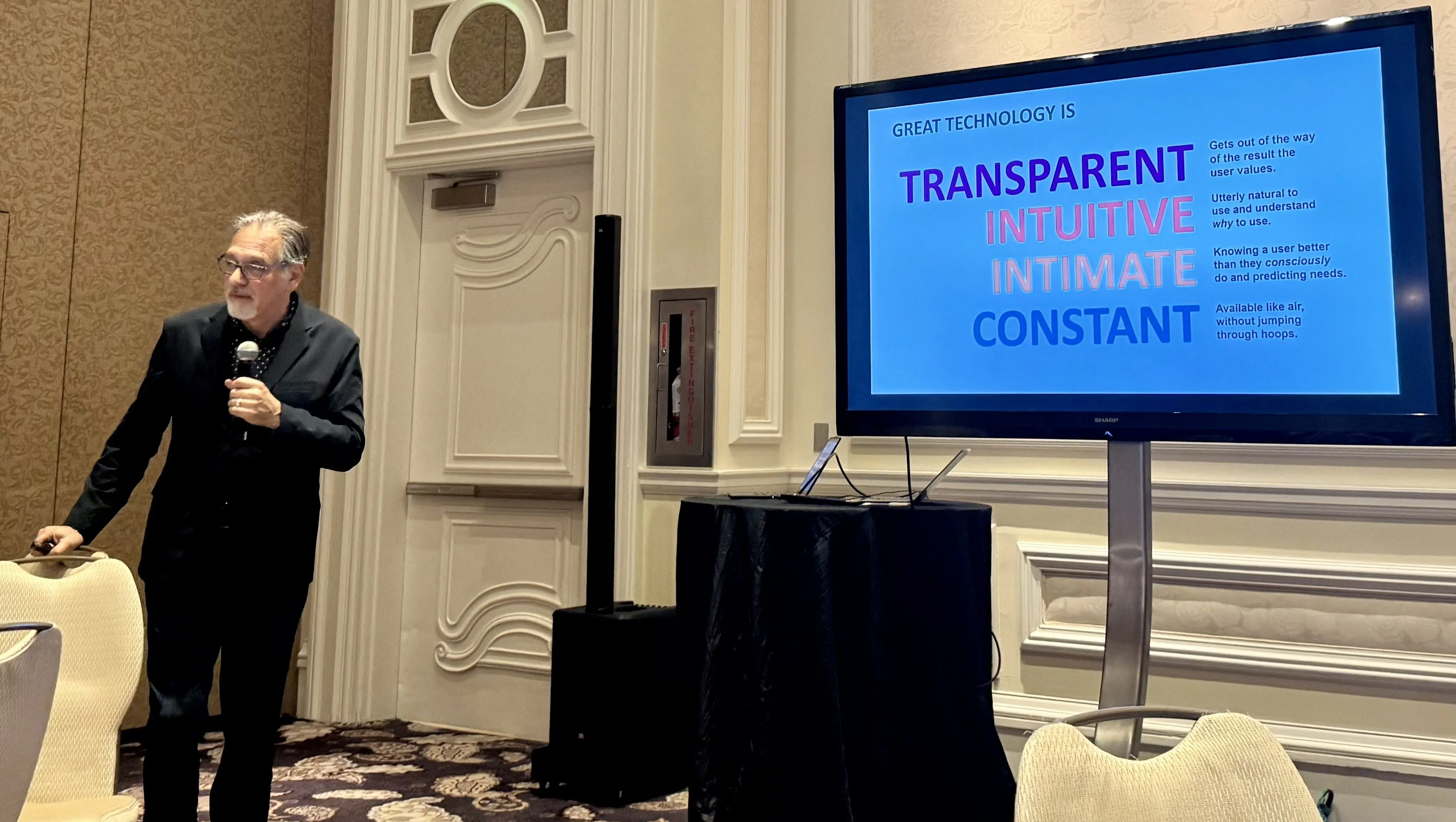
During this exclusive session, Brian Cooley, CNET Tech Editor at Large and a longtime friend and collaborator of Canvas Worldwide, shared the grounded, experience-driven perspective our audiences have come to value — cutting through the hype to focus on the trends that matter, the ones that don’t, and the patterns that continue to repeat themselves across decades of innovation!
Why 20% Adoption Changes Everything
One of the clearest takeaways from Cooley’s perspective is the enduring power of adoption curves.
Time and again, technology follows a familiar pattern: slow uptake, prolonged skepticism, and then — once roughly 20% adoption is reached — rapid acceleration toward mass adoption. Fifty percent, Cooley noted, is a powerful position. From there, success is no longer about proving relevance; it’s about maintaining it.
This insight is especially relevant as the industry eyes the future of in-home assistants, connected devices, and robotics. Whether the winner is a general-purpose home robot or an ecosystem of specialized tools, the company that breaks through that 20% threshold first is likely to define the category.
When the Best Tech Doesn’t Win
Another recurring theme: technological superiority alone doesn’t guarantee scale.
Television operating systems are a perfect example. While platforms like Roku continue to deliver strong consumer experiences, market dynamics, partnerships, and monetization strategies often dictate which systems survive at scale. In some cases, hardware becomes secondary to the value of data, ad networks, and platform control.
It’s a reminder that innovation lives at the intersection of product, business model, and ecosystem — not in any one dimension alone.
From Apps to Agents
Perhaps the most forward-looking insight from the session centered on a shift already underway: the move from apps to AI agents.
We’ve all felt the friction of the app economy — especially in streaming, where navigating platforms can mean missing the moment you’re trying to watch. Cooley pointed to a near future where consumers won’t open apps at all. Instead, they’ll simply tell an agent what they want, and the agent will handle the rest.
This evolution challenges the long-held belief in the “super app.” In an AI-driven world, bundling a limited set of services begins to feel restrictive. Consumers don’t want a curated menu — they want their world, assembled dynamically and intelligently around them.
What Happens to Websites?
Follow that logic far enough, and another provocative idea emerges: the gradual disappearance of traditional websites.
If consumers can move directly into immersive, interactive experiences — shopping, exploring, engaging — why navigate a homepage at all? As spatial computing and AI mature, brands may no longer need to pull people in step-by-step. Instead, experiences will come to the consumer, fully formed and contextually relevant.
Some of the most visionary marketers are already asking this question: Is the website becoming an unnecessary middle step?
Looking Ahead
CES will always be loud. But the most meaningful insights rarely come from spectacle — they come from pattern recognition, experience, and a willingness to challenge comfortable assumptions.
At Canvas, we believe the future belongs to brands and platforms that can see beyond the noise, understand human friction, and build experiences that feel intuitive, not imposed.
As Cooley put it, despite the uncertainty and rapid change, there is still reason for optimism.
And as we look ahead, we feel good about what’s coming next! Thank you to all who joined our session at CES — we hope to see you again at CES 2027!